October 11th 2026
What Can I Do With a Sloped Backyard in Asheville, NC?
A sloped backyard can be one of the most frustrating parts of an Asheville property.
It can be awkward to mow, difficult to walk across, prone to runoff and short on genuinely usable space.
But a slope does not automatically mean a useless yard.
Some of the best outdoor spaces are created by working with the elevation instead of trying to remove it completely.
Depending on the property, a sloped yard could become a terraced garden, a level patio, a planted hillside, a deck, a series of steps and walkways, or a combination of several of these.
The right solution depends on the slope, drainage, access and how you actually want to use the space.
For more information check out this blog: Landscape Installation in Asheville
Can You Make a Sloped Backyard Usable?
Usually, yes.
But that does not necessarily mean flattening the whole thing.
When homeowners say they want to “level the backyard,” what they often really mean is: “I want somewhere I can actually use.”
That might only require one level area for a patio, fire pit or seating space.
Another section could remain planted. A steeper area might work better as a terrace. Steps or a walkway can connect everything together.
Instead of fighting the entire hill, it often makes more sense to decide which parts need to become usable and which parts can stay sloped.
Should You Flatten a Sloped Backyard?
Sometimes, but not automatically.
Flattening land can involve excavation, grading, retaining walls and drainage. Once you start changing levels, you also have to think about where rainwater will travel afterwards.
That is why the better answer is often not to flatten the whole yard. It may be to create one or two useful level areas while allowing the rest of the property to follow its natural shape.
Is Terracing a Good Option?
Yes, especially on steeper properties.
Terracing breaks one long slope into a series of smaller levels. That could create a patio on one level, planting on another and a garden or lawn lower down.
Retaining walls can hold those levels in place where needed. Terracing works well because it turns the slope into part of the design rather than treating it as something that has to disappear.
Do I Need a Retaining Wall?
Maybe.
Retaining walls are useful where soil needs to be held at a different level. They can help create patios, terraces and more usable yard space.
But not every slope needs a wall. Some gentler slopes can be graded or planted instead. And when a wall is required, drainage behind it matters just as much as the visible structure.
For more on retaining walls, check out our blog: Retaining Wall Contractors in Asheville
Heart to Home of Asheville Project:
For this project the Heart to Home team took an unusable steep slope and turned it into a functional area for planting! We created a multi-tiered retaining wall that not only controls erosion but also provides a stable, buildable area for our clients. No more wasted space on this hill! This new garden bed is perfectly prepared for planting and ready to be transformed. See photo below.
Can You Build a Patio on a Sloped Yard?
Yes.
A patio needs a stable, properly prepared base. On a slope, creating that base may involve excavation, grading, retaining work, drainage and safe access. Sometimes the best patio location is not where the homeowner first imagined it.
Views, water movement, access and how the patio connects to the house all matter. The goal is to create a useful space that works with the rest of the property.
For more on patios, check out our blog: Patio Installation in Asheville
Would a Deck Work Better?
Sometimes.
If the property drops steeply away from the house, a deck can create usable outdoor space above the slope without needing to flatten the ground below.
That can work particularly well on properties with a view. And it does not have to be deck or patio. Some yards work beautifully with an upper deck and a lower patio or landscaped area.
For more information, read here: Deck Builders in Asheville
How Do You Get Around a Steep Yard?
Access should be part of the design from the beginning.
That might mean stone steps, landscape stairs, walkways or landings between levels.
On a steep property, following the shape of the land can feel more natural than forcing a straight route directly up and down the hill.
For inspiration, check out these links:
Outdoor Steps / Stone Steps article
What About Water Running Down the Slope?
This needs to be considered before patios, walls and planting go in.
On a steep property, runoff can contribute to erosion, wash out planting or collect around patios and retaining walls. Depending on the property, the solution might involve grading, swales, French drains, drainage pipe or other erosion-control measures.
The important thing is understanding where the water comes from, where it travels and where it can safely go.
Read more here: Drainage & Grading in Asheville
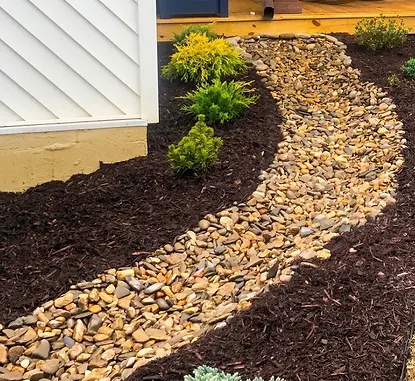
We designed and installed a functional river rock dry creek bed to manage water runoff and provide a permanent drainage solution for a newly constructed residential portico in the mountains of North Asheville. This feature, situated along the base of the white siding, collects heavy rainfall from the roofline and guides it away from the foundation. We layered various sizes of mixed brown and grey river stone for natural water flow, bordering the channel with premium dark double-shredded mulch to create distinct garden beds. To add texture and year-round visual interest, we incorporated key plant specimens, including dwarf golden juniper and a globe blue spruce, creating a low-maintenance, arid-garden feel that complements the custom portico. The resulting landscape is both aesthetically pleasing and structurally sound.
Can Plants Help on a Sloped Yard?
Definitely. Not every slope needs to become lawn.
Shrubs, grasses, perennials and ground cover can create a better-looking and easier-to-maintain hillside. Planting can also help protect exposed soil and soften the appearance of walls, steps and other hardscape.
The key is choosing plants for the actual conditions, including sun, soil, moisture and how easy the area will be to maintain.
For more info, read here: Landscape Installation in Asheville
Should You Work With the Slope Instead of Against It?
Often, yes.
A slope gives you different levels, views and natural separation between spaces. A dining area could sit on one level while a fire pit sits on another. Planting can layer up the hillside. Stone steps can become a feature.
Sometimes the thing that looks like the biggest limitation is what gives the finished space the most character.
What Should Be Done First?
Start with how you want to use the yard. Then work through the site in the right order:
1. Understand water and drainage.
2. Decide which areas need to become level.
3. Plan retaining or grading.
4. Build patios, steps and walkways.
5. Finish with planting.
In other words: Function first and good looking second.
So, What Is the Best Solution for a Sloped Backyard?
There is no single answer.
One property might need a retaining wall and patio. Another might work better with a deck. One slope might become planted terraces. Another may need drainage corrected before anything else is built.
The better question is not:
“How do we get rid of the slope?”
It is:
“How do we make the property work?”
Have a Sloped Yard in Asheville?
A slope does not have to be the part of your property you avoid.
With the right combination of grading, drainage, retaining, hardscaping and planting, it can become one of the most useful and interesting parts of the yard.
At Heart to Home of Asheville, we design and build landscapes around the property that is actually there.
Hills included.
If you're trying to work out what to do with a sloped backyard in Asheville or the surrounding area, show us what you're working with.
Request a free estimate from Heart to Home of Asheville or call (828) 215-5868.