August 11th 2026
Outdoor Staircases & Stone Steps in Asheville, NC: Making a Slope Walkable
There's a spot on a lot of Asheville properties that everyone in the household quietly negotiates every single day.
That bank you scramble up to reach the top of the garden. That muddy slope between the driveway and the door. That stretch where walking with a guest, a grandparent, or a full laundry basket turns into a small adventure.
A good outdoor staircase makes that spot vanish from your attention entirely. You just walk it, without thinking, the way you're meant to.
This guide covers why steps are worth getting right, the materials that work on a WNC slope, the engineering underneath that keeps them safe, and how a well-built staircase ties a sloped property together.
The Thing You Use Every Day And Only Notice When It's Wrong
As home features go… steps are strange.
Let me explain this.
When they're right, they're invisible. When they're wrong, you feel it every single time.
A good staircase has a rhythm. Every step is the same height and the same depth, so your body finds the pattern after the first one and stops thinking about it. The treads are deep enough to land a whole foot. The whole thing drains, so it isn't slick after rain or treacherous after a frost. You climb it carrying a box you can't see over and it just works exactly as you’d expect and hope.
A bad staircase breaks that rhythm. One step is taller than the rest, so you catch the same toe in the same place every time. The treads are too shallow, or they pitch backward and hold water, or they've shifted over a season until nothing sits level. Steps like that aren't just annoying. On a slope, in the wet, they're the part of the property most likely to put someone on the floor with a bang. No one wants an unexpected medical bill.
Getting steps right isn't a luxury... It's the difference between a slope you use and a slope you avoid.
The Materials That Work On A Slope
Outdoor steps get built from a handful of materials here, and the right one depends on the setting and the job.
Natural stone steps are the ones that look like the mountain arranged them, dry-stacked or set, full of character, and completely at home in a WNC landscape (link: stonework page). They're the premium choice and, in the right setting, unbeatable to look at.
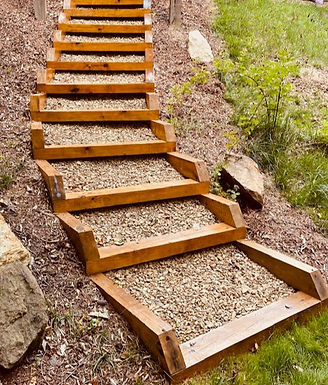
Timber steps, built from heavy landscape timbers, are warm, informal, and well-suited to a garden or a woodland path. They're often the friendliest option on the budget and they settle into a natural setting beautifully. The one honest caveat is the same as any outdoor wood, they won’t last forever, so drainage and good construction matter even more.
Block and paver steps, built from the same segmental units used in walls, give a clean, engineered, consistent look and tie in neatly where there's already a paver patio or a block retaining wall (link: patios page). On a property where steps meet a wall, building them from the same system makes the whole thing read as one considered piece rather than separate jobs (Retaining Wall Contractors in Asheville, NC).
The best choice is whichever suits how the space looks, how it's used, and what it needs to connect to.
Outdoor Steps Heart to Home Project
This project involved the construction of a rustic outdoor staircase designed to provide safe and practical access across a sloped landscape. The steps were built using sturdy timber beams, creating a natural and attractive structure that blends well with the surrounding environment. Each step is filled with compacted gravel, providing good drainage, stability, and a durable walking surface. The timber edging helps retain the gravel and prevents soil erosion, while the stepped design follows the natural gradient of the ground. Overall, the project combines functionality, durability, and a natural aesthetic, making the pathway both safer to use and visually appealing.
The Part That Keeps Them Safe: What's Underneath
Here's what separates a staircase that lasts from one that shifts, and it's mostly the things that you cannot see with your eyes.
Steps live or die on their foundation and their drainage.
Built on a properly prepared, compacted base, with each step keyed into the slope and water given a route to drain away, a staircase stays level and true for decades. Built straight onto soft or unprepared ground, it starts to move with the first wet season, and once steps begin to shift, that consistent rhythm you never noticed becomes a trip hazard you notice constantly.
If you’ve read our drainage blogpost, you’ll know this already, but water is typically the usual culprit. Steps that don't drain hold moisture, and moisture on a slope means movement in the wet, ice in the cold, and rot where there's timber. It's the same lesson that runs under every good outdoor project here, sort the water and half of your potential problems thankfully never happen (Drainage and Grading in Asheville, NC).
So when you're getting quotes, ask what's going underneath. The builder who talks about the base, the drainage, and keeping every step consistent is the one building a staircase you'll still trust in ten years, and not one that begins shifting away from where it was set soon after.
What Outdoor Steps Cost
Steps are more involved than they look, so it's worth setting expectations honestly.
Cost depends on the material, the number of steps, the steepness of the slope, and how much groundwork the site needs before a single step is set.
A short run of timber steps on stable ground is a modest job. A long flight of stone steps cut into a steep bank, with proper foundations and drainage, is a considerable one.
Access, as ever on a WNC slope, moves the number.
The thing worth paying for is the part you can't see, the base and the drainage that keep the steps safe and level long after the build is done.
Otherwise whatever you do pay will prove not worthwhile as you will need to resolve issues later down the line.
What Next?
A staircase is one of the few things you build once and then use, quite literally, every day.
Done well, it disappears underfoot, turning an awkward slope into somewhere you move without a second thought, safely, in every season, for years.
Done badly, it becomes the part of the property everyone quietly dreads, and eventually the part someone unfortunately gets hurt on.
So you don’t ideally want to aim for the cheapest set of steps. You want the builder who gets the rhythm right and the foundation solid, so you never have to think about your steps again.
Because the best staircase is the one you forget is even there, and not one that classifies as a hazard.
If that's what you're after, that's what we do.
Tell us about the slope you're fighting, where you need to get to, and how you'd like it to look, and we'll come and take a look. We'll work out the safest, best-looking way up.
Request a quote or call us on (828) 215-5868. We'll take it from there.